“Penitent” – The Art of Complexity

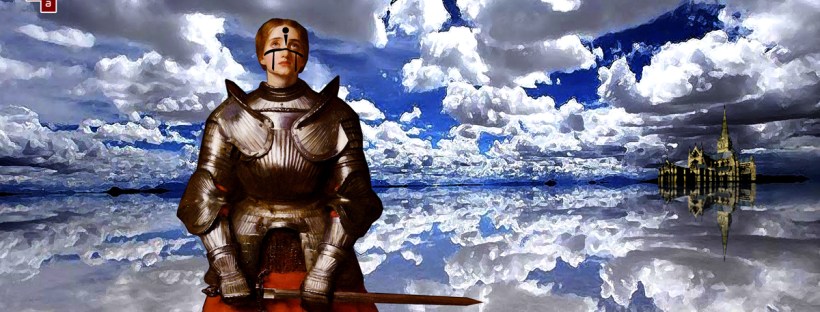
Several weeks ago, I started whining at artist David Tanimura to make a piece about Joan of Arc.  David is an amazing digital collage artist – and one of my oldest friends. I must be persuasive – or, more likely David is incredibly kind.  Because soon, David brought me a surprise: a picture of Joan of Arc that was more beautiful than I could have ever envisioned.

I love Joan of Arc because I love stories about women in history who dressed up as men and have adventures.  Often these stories are the stuff of legends – they’re larger than life, only half true, and their significance is more complicated than many people (myself included) want to admit.  But there’s another truth about these stories: they point to a future.  For me, the story of Joan of Arc is about the malleability of gender and the fact that those who transgress gender boundaries cannot be silenced, even in death.  The story of Joan tells me that there is a way for me, as a queer person, to break through boundaries, stand up for myself, and be triumphant.  I love St. Joan and my love for her is a way of loving myself.

Of course, the story I tell myself about Joan of Arc isn’t the same as the one embraced by the Catholic Church or validated in the historical record or Catholic Church tell.  Joan is, in many ways, a very conservative figure.  She likely dressed in men’s clothing only occasionally and it was almost certainly not a reflection of her gender identity.  In fact, records indicate that when she was held captive, Joan requested women’s clothing, but her jailers denied it to her to create a pretense for her execution.  Trial transcripts indicate that Joan insisted on her purity and holiness to the last.  She is now a saint because the modern Catholic Church has decided to agree with her.

But cross-dressing women saints are a delightfully common theme in medieval Europe.  For example Saint Uncumber, the story goes, prayed to be saved from an unwanted marriage and then grew a beard overnight.  Even the Catholic Church can’t quite extinguish the queerer side of Joan.  In icons, St. Joan is often accompanied by butterflies – a symbol of transformation.

That’ll do just fine for me, thanks.

That’s the thing about the saints: they’re about a multiplicity of truths.  Maybe we each need a bit of lore that reflects us specifically.  It is my (blasphemous) opinion, that the saints are about the holy power of imagination.

All of this makes David’s art the perfect medium for exploring Saint Joan and other saints and legends.  David takes his own photographs, combines them with existing images, and runs it all through a magical process called photoshop to create new pieces of art.  It’s modern alchemy.  The results are beautiful.

David’s piece about St. Joan tells a story that is a little bit different than the story that I like to tell about the girl warrior.  David titled the piece “Penitent.”  He pictures a self-reflective Joan kneeling on a reflective surface.  This is a Joan who has actually been through a war.  It’s Joan before the butterflies.  And it’s a perfect addition to David’s body of work, much of which deals with war and its consequences.

In all honesty, this is the Joan that I need to spend more time with.

On his blog, David accompanies his art with quotations.  For “Penitent,” David selected a particularly beautiful one: Faith is the strength by which a shattered world shall emerge into the light.”  Who said this gem?  Another misunderstood saint: Helen Keller.

While the legend of Joan of Arc may be more interesting than the truth about her, the real life of Helen Keller is far more interesting than the sanitized version told in children’s picture books.  Yes, Helen Keller was both blind and deaf and she turned what other people saw as limitations into strengths.  Helen was also a member of the Socialist Party and the International Workers of the World.  She helped to found the ACLU and campaigned for women’s suffrage.  She was one of the earliest advocates for disability rights in the United States.  Never content with the roles assigned to her or other exploited people, Helen denounced the rich and powerful in the sort of language that still scares people today:

The few own the many because they possess the means of livelihood of all … The country is governed for the richest, for the corporations, the bankers, the land speculators, and for the exploiters of labor. The majority of mankind are working people. So long as their fair demands—the ownership and control of their livelihoods—are set at naught, we can have neither men’s rights nor women’s rights.

You see, Helen was a warrior, just like Joan.

These are the sort of connections that David’s art weaves together.  Besides “Penitent,” I have three more of his pieces displayed on the walls of my apartment – Artemis, IkuZo!, and Gaia’s Lament.  I chose these because they are all images that I want to haunt my dreams.  Unlike David, I have no gift for visual art.  But each of these pieces relate to stories I want to tell.  I keep them on the walls to remind me, to whisper ideas until their voices grow too loud for me to ignore.

It takes a special artist – and a special person – to create work that speaks such complex truths.  David posts all of his art online at his website.  Take a look and see what stories you find.

Beyond the Flame: How the Olympics Distracts us from Transnationalism

When Kyla Harrison became the first American to win a gold medal in judo, I got excited.  Sure, I was excited because I love judo as a sport.  I’ve practiced judo off and on for almost ten years and love watching it.   But that’s not what I felt.  As a radical dissident, patriotism has never appealed to me.  But there’s something about watching US women’s sports that made me feel strangely connected to the United States.  Almost proud to be an American.   That’s when I realized what, behind the sports, the Olympics is all about.

Nationalism.  And the Olympics can help us understand its nature and why we must start thinking beyond it.

The rest of my article can be read on In Our Words.  I’m excited to be a new contributor to this blog!

Hollowstone: An interview with author Dennis Upkins

I’m very excited to interview author Dennis Upkins about his new novel Hollowstone as a part of his virtual book tour.  We had a great chat about Hollowstone, writing and activism and, of course, comics.  Check out Dennis insightful answers and pick up your own copy of Hollowstone.


Q:  Can you tell us briefly what Hollowstone is about?

A:  Life for Noah Scott changes drastically when he is accepted to Hollowstone Academy, one of the most prestigious boarding schools in the country set in the mountains of Eastern Tennessee. Within the hallowed halls of the illustrious school, Noah soon discovers that the world of the privileged is rife with social hierarchies, politics, depravity and corruption. It is also there that Noah meets his roommate and best friend, the charming and enigmatic Caleb Warner.

Tragedy soon strikes when Cal is brutally murdered in a hold-up. But when Noah is haunted by Cal’s ghost, he soon discovers that the random act of violence was in fact a premeditated one. Determined to uncover the truth and find Cal’s killer, Noah soon finds that the school and its patrons have more than their share of secrets. Secrets they are willing to preserve at any cost. Noah also quickly learns that greater supernatural forces are at play. In a race against time, Noah must solve Cal’s murder before he’s the killer’s next victim.

Q: Most of my readers are interested in Palestine and the Middle East. Why should someone with those interests read Hollowstone?

I think good storytelling, engaging characters, a smart plot, a powerful story, all of those things are universal. One of the inspirations for Hollowstone was the Great Gatsby. Now I’m not a white male who lived during the twenties, but I was able to relate to Nick Carraway and Jay Gatsby.

And I think the same applies to Hollowstone. It’s about flawed characters trying to function is a broken world. I think their journeys will be relatable to any reader, regardless of their background.

One thing storytelling has taught me time and time again is that while our cultures and customs may vary, ultimately, we as a people have far more in common than most of us realize.

Q:  Do you think that writing can be form of activism? Can storytelling help to build community and social change?

A:  Absolutely. No question about the pen truly being mightier than the sword. Whether it’s Martin Luther’s 95 Theses or Dr. Martin Luther King Jr.’s Letters From A Birmingham Jail. The Diary of Anne Frank, the Harlem Renaissance, writing can reach hearts and minds in the deepest of ways. And the impact they can make can be more powerful than any weapon.

Q:  Hollowstone is full of the sort of totally awesome, powerful characters who normally aren’t represented in the media. I’m really curious about Neely Daniels, whom you’ve described as “spunky, outspoken, and not afraid to be her own woman” and “a bisexual Wiccan teen in a Southern conservative prep school, Neely is accustomed to being treated as an outcast for being true to herself.” I’ll be honest, I’m pretty excited because off the top of my head, I can’t think of another bisexual character in a YA novel. Can you tell us a little bit more about her? Did you have any trouble convincing your editors and publishers that Neely and your other queer characters were “appropriate” in a YA book?

A:  I’ve gotten so much positive feedback about Neely and I’m excited that she’s gone over well with so many readers.

While she doesn’t appear until the second half of the novel (there’s a reason for that), she’s the main character of Hollowstone, following Cal and Noah. Essentially she arrives at Hollowstone to investigate the murder of her brother. She soon finds herself teaming up with Noah to get answers in a school that would sooner keep their secrets at all cost. One thing that I think makes her appealing is that this a young woman who takes charge. She doesn’t wait on the sidelines or wait to be rescued. She saves herself and does plenty of rescuing on her own as the novel will illustrate. When it comes to stories of characters investigating/avenging the death of a loved one, the role of the investigator/avenger is usually reserved for male characters. It’s rare that female characters take point in storylines like this and it’s even rarer to have a bisexual character in media period, much less in a leading role. Neely is young woman who is force to be reckoned with in her own right. In addition to being an accomplished martial artist (which comes in handy more than once), she possesses limited psychic ability due to a near death experience at a young age. She can see the auras of others, sense supernatural fluctuations and is the only other person aside from Noah who can see Cal’s ghost.

Thankfully no convincing was necessary with my publisher (Parker Publishing) but I know that would’ve been an issue with many other publishers. In fact it was when I was making the submission rounds. Unfortunately the industry is still a very racist and homophobic one and it’s not coincidence that there’s a dearth of POC and LGBTQ-lead stories.

Parker’s tagline is Quality Fiction For Readers Of Distinction. It’s an independent publisher that celebrates black, multicultural, interracial, and multiethnic voices. With their audience, as well as their staff being primarily women of color, they understand intersectionality, just as I do being a queer person of color. They understand the importance of promoting marginalized characters in an honest and positive light.

So thankfully, that was a non-issue with them.

Q:  Hollowstone is a novel, but I know you also love comics. What’s your favorite author or series? Any love for non-fiction comics and graphic novels?

A:  You mean I have to pick just one? LOL!

X-Men will always holds a special place in my heart because it’s based on the Civil Rights movement and today it represents any type of struggle against bigotry and institutional oppression. One of the things that definitely made X-Men unique and I hope they eventually return to is that there was no hierarchy.

Before the comic devolved into The Wolverine Show & His 150 Sidekicks, every character was equally developed and anyone could take center stage with a front-burner storyline at anytime: be it Rogue and her struggles with her powers, Angel and his ongoing battles with Apocalypse, Psylocke, Bishop, etc. The diversity was also one of the key components to X-Men’s initial success in my opinion. This is the series gave us Storm, one of the most iconic characters of all time and the first lady of Marvel comics.

With the X-Men, the characters came from all walks of life and that appealed to a wide demographic of fans. There was a hero and a heroine for everyone and it worked. Excellent conscious stories, compelling characters and respect to diversity is what contributed to X-Men becoming one the best-selling comics of all time.

Buffy the Vampire Slayer: Season 8. Each time I get a new issue, I’m immensely giddy with excitement because I can’t wait to see where the characters are going to be taken next.

I also love the Reginald Hudlin run of the Black Panther with Shuri as the titular heroine. It’s one of the few titles which celebrates African culture/three-dimensional compelling black characters with respectability. The art is enjoyable and the stories are a perfect blend of action, adventure, fantasy and conscious social political commentary. For 15 minutes I’m taken to a world where being black isn’t a scarlet letter but a badge of honor, one of vibranium even.

Midnighter was another series I adored. And I won’t even go into my love of the Cassandra Cain run of Batgirl, less I be counting the ways for the next 10 years.

In regards to non-fiction comics, I’ve immensely been enjoying the Blue Water biography series which has done comic features on the lives of JK Rowling, Michael Jackson, Oprah Winfrey and Bill Clinton.

Send Us to Camp!: Fundraising for the 2011 At-Tuwani Summer Camp with Humanity Together

We at Humanity Together recently got an email asking if we would be willing to raise the money for the 2011 At-Tuwani Summer Camp.   Our answer?   Of course!  The Tuwani Summer Camp is an annual event about which I care deeply.   For the children of the At-Tuwani-area (and, quite honestly, the internationals working in the village as well) summer camp is one of the highlights of the summer.   Summer Camp is two weeks of games, dancing, sports, and lots of laughter and it couldn’t be more important to the kids of the village.  As Keifah, the director of the Women’s Cooperative says, “We want our children to see that live is still beautiful, even under military occupation.”

Below is the fundraising video I put together on Humanity Together’s behalf.  For donation information, visit our facebook page.

Flash-mob! A Land Day and Global BDS Day of Action Demonstration

In honor of Palestine’s Land Day and as a part of the Global BDS Day of Action, I got to work with some fabulous activists to organize a flash-mob here in Chicago.  This was a tough, but very energizing – and successful – project.  Though I can’t dance to save my life, I enjoyed re-writing the lyrics to the Jackson Five’s “ABC” and organizing our media strategy. Our video got over 2,000 hits in the first 24 hours and has now been watched over 13,000 times.   Enjoy and keep sharing!

Chicago Activists Mark Palestinian Land Day with Boycott, Divestment and Sanctions Flash-Mob

“BDS” song available for download: http://vocalo.org/blogs/archive/201103/boycott-divestment-and-sanctions-jacks…

On March 30th at 5 pm, a group of social justice activists held a “flash-mob” in downtown Chicago. The demonstration was organized as one of hundreds of demonstrations held around the world to mark the Boycott Divestment and Sanctions Global Day of Action, an annual event designed to call attention to the movement to boycott the apartheid policies of Israel. Demonstrators performed a choreographed dance to an original song called “BDS,” a parody of “ABC” by the Jackson Five.

“In the lyrics to our song, we sing ‘apartheid and ethnic cleansing go on in Palestine every day, but without the help of you and your money, the occupation will go away.’ While the struggle to end Israel’s apartheid policies is not an easy one, it’s true that we in the United States can support justice and peace by refusing to support companies and institutions that support Israel and its occupation of Palestine,” said Joy Ellison, an activist with Palestine Solidarity Group-Chicago (PSG-Chicago). “We hope that this flash mob empowers our community to stand up against apartheid and challenges Chicago businesses and institutions that are actively supporting the oppression of the Palestinian people.”

Before this performance at “The Bean,” the flash mob was held outside of Chicago Cultural Center, home of the Chicago Sister Cities International office. For the last two years, activists with PSG-Chicago have pressured the city of Chicago to end its relationship with its Israeli sister city, Petach Tikva. Petach Tikva, an officially segregated city, is the first Jewish-only settlement in historic Palestine and the site of the primary detention center where Israeli forces abuse and torture Palestinian political prisoners. Human Rights group Amnesty International dubbed Petach Tikva “Israel’s Guantanamo.”

For more information, go the website of the Palestinian BDS National Committee (BNC) at http://www.bdsmovement.net