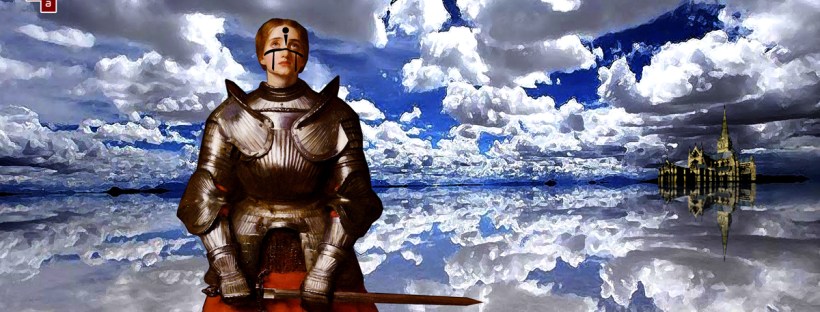
Several weeks ago, I started whining at artist David Tanimura to make a piece about Joan of Arc. David is an amazing digital collage artist – and one of my oldest friends. I must be persuasive – or, more likely David is incredibly kind. Because soon, David brought me a surprise: a picture of Joan of Arc that was more beautiful than I could have ever envisioned.
I love Joan of Arc because I love stories about women in history who dressed up as men and have adventures. Often these stories are the stuff of legends – they’re larger than life, only half true, and their significance is more complicated than many people (myself included) want to admit. But there’s another truth about these stories: they point to a future. For me, the story of Joan of Arc is about the malleability of gender and the fact that those who transgress gender boundaries cannot be silenced, even in death. The story of Joan tells me that there is a way for me, as a queer person, to break through boundaries, stand up for myself, and be triumphant. I love St. Joan and my love for her is a way of loving myself.
Of course, the story I tell myself about Joan of Arc isn’t the same as the one embraced by the Catholic Church or validated in the historical record or Catholic Church tell. Joan is, in many ways, a very conservative figure. She likely dressed in men’s clothing only occasionally and it was almost certainly not a reflection of her gender identity. In fact, records indicate that when she was held captive, Joan requested women’s clothing, but her jailers denied it to her to create a pretense for her execution. Trial transcripts indicate that Joan insisted on her purity and holiness to the last. She is now a saint because the modern Catholic Church has decided to agree with her.
But cross-dressing women saints are a delightfully common theme in medieval Europe. For example Saint Uncumber, the story goes, prayed to be saved from an unwanted marriage and then grew a beard overnight. Even the Catholic Church can’t quite extinguish the queerer side of Joan. In icons, St. Joan is often accompanied by butterflies – a symbol of transformation.
That’ll do just fine for me, thanks.
That’s the thing about the saints: they’re about a multiplicity of truths. Maybe we each need a bit of lore that reflects us specifically. It is my (blasphemous) opinion, that the saints are about the holy power of imagination.
All of this makes David’s art the perfect medium for exploring Saint Joan and other saints and legends. David takes his own photographs, combines them with existing images, and runs it all through a magical process called photoshop to create new pieces of art. It’s modern alchemy. The results are beautiful.
David’s piece about St. Joan tells a story that is a little bit different than the story that I like to tell about the girl warrior. David titled the piece “Penitent.” He pictures a self-reflective Joan kneeling on a reflective surface. This is a Joan who has actually been through a war. It’s Joan before the butterflies. And it’s a perfect addition to David’s body of work, much of which deals with war and its consequences.
In all honesty, this is the Joan that I need to spend more time with.
On his blog, David accompanies his art with quotations. For “Penitent,” David selected a particularly beautiful one: “Faith is the strength by which a shattered world shall emerge into the light.” Who said this gem? Another misunderstood saint: Helen Keller.
While the legend of Joan of Arc may be more interesting than the truth about her, the real life of Helen Keller is far more interesting than the sanitized version told in children’s picture books. Yes, Helen Keller was both blind and deaf and she turned what other people saw as limitations into strengths. Helen was also a member of the Socialist Party and the International Workers of the World. She helped to found the ACLU and campaigned for women’s suffrage. She was one of the earliest advocates for disability rights in the United States. Never content with the roles assigned to her or other exploited people, Helen denounced the rich and powerful in the sort of language that still scares people today:
The few own the many because they possess the means of livelihood of all … The country is governed for the richest, for the corporations, the bankers, the land speculators, and for the exploiters of labor. The majority of mankind are working people. So long as their fair demands—the ownership and control of their livelihoods—are set at naught, we can have neither men’s rights nor women’s rights.
You see, Helen was a warrior, just like Joan.
These are the sort of connections that David’s art weaves together. Besides “Penitent,” I have three more of his pieces displayed on the walls of my apartment – Artemis, IkuZo!, and Gaia’s Lament. I chose these because they are all images that I want to haunt my dreams. Unlike David, I have no gift for visual art. But each of these pieces relate to stories I want to tell. I keep them on the walls to remind me, to whisper ideas until their voices grow too loud for me to ignore.
It takes a special artist – and a special person – to create work that speaks such complex truths. David posts all of his art online at his website. Take a look and see what stories you find.